
Adding a Food Truck to Your Restaurant: The Real Numbers
- restaurant-margins
- food-trucks
- catering
- second-unit
You already paid for the expensive part of a second location. You just haven’t put wheels under it yet.
If you run a restaurant, you own a permitted kitchen, a trained crew, vendor accounts, a menu people already ask for, and, if things are going even halfway right, a name that means something within a few miles of your front door. A second restaurant makes you buy most of that again, plus a lease. A food truck mostly borrows it.
That’s the pitch, and I mostly believe it. But “mostly” is doing real work in that sentence, so let’s go through the whole thing, starting with where the money actually comes from.
I ran this experiment backwards
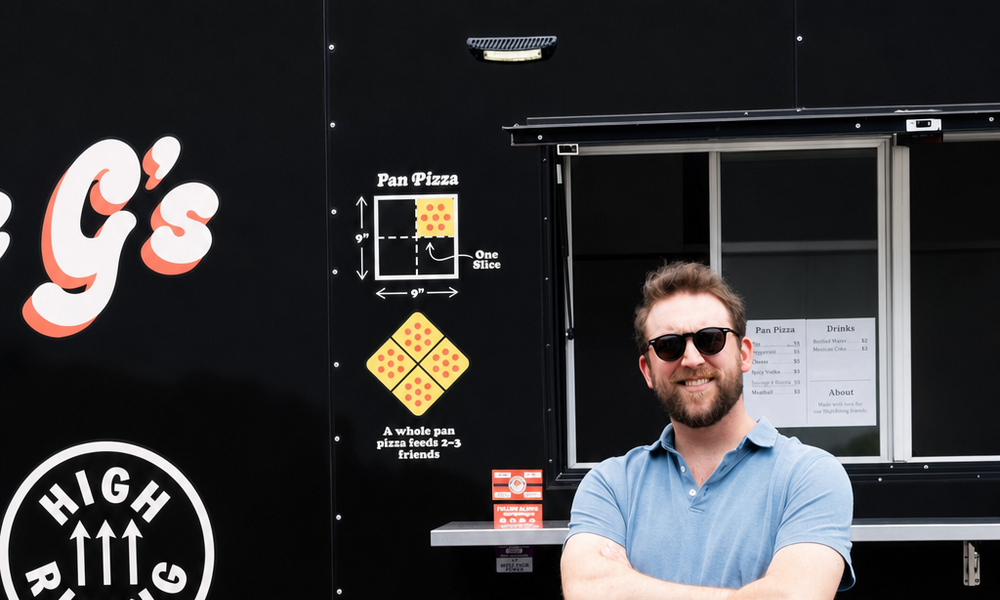
I didn’t add a truck to a restaurant. I added a restaurant to my trucks. Started making pizza out of my house during the pandemic, put $20k into an ugly first truck in 2021, and did $110k that first year. Added a second truck in 2022 and did $550k. In 2023 the two trucks did $1.1M. No restaurant, no dining room, no lease with my name on it. The restaurant came in 2024, and the whole thing together did $1.4M.
So when a restaurant owner asks me whether a truck can be real revenue, I don’t hand them an industry report. I can’t. I don’t trust most of the ones I’ve read, and I’m not going to quote you a tidy “trucks add 22%” stat that some content farm made up. What I can tell you is that a food truck is not a food cart with dreams. Mine cleared a million dollars a year before I owned a single table. The revenue is real if the work is real.
What the backwards order taught me is exactly why the forwards order (restaurant first, truck second) is easier than what I did. I had to build the kitchen infrastructure, the prep systems, and the customer base from a truck. You already have all three. You’re starting from the part I had to earn.
Where the new revenue actually comes from
“More sales” is not an answer, so here’s the specific money a truck reaches that your dining room can’t.
Catering and events with a deposit attached. This is the big one, and it’s the reason I’d tell most full-service operators to think about a truck at all. Weddings, corporate lunches, graduation parties, breweries that have taps but no kitchen. These are priced jobs: you quote them, they pay a deposit, you know your revenue before you light a burner. A truck turns “we cater!” from a line on your website into a vehicle that shows up. My trucks’ event calendar is the spine of their revenue, and it’s booked weeks out in season.
Recurring sites you could never lease. The office park that empties into the street at 11:45. The brewery on Thursday nights. The Saturday farmers market. None of those neighborhoods will ever support your second lease, but all of them will support four hours of your truck once a week. String together five or six recurring sites and you’ve built a route: predictable revenue from real estate you rent by the appearance.
The daypart your building can’t do. Plenty of dinner-house operators have a lunch problem: the room, the staffing model, or the location just doesn’t work at noon. A truck can go be your lunch service somewhere lunch actually happens, without touching how the restaurant runs at night.
A rolling billboard that pays you. I resisted putting this one in, because “it’s marketing!” is how people justify trucks that lose money. But it’s true and I’ve lived it: the truck introduces your food to people who then show up at the restaurant. Just do the accounting honestly. The truck has to stand on its own P&L and it markets the mothership. It doesn’t get to lose money and call the loss advertising.
And the counterweight: trucks are seasonal in most markets. Mine slow down when the weather turns. If your restaurant already sags in winter, the truck sags with it, so plan the cash that way instead of being surprised by it.
Why your restaurant makes the truck cheaper
A standalone truck startup has to solve problems you’ve already solved.
The commissary problem. Most health departments require a truck to work out of a licensed commercial kitchen: prep, dish, water, waste. Standalone operators rent one at $300–$1,500 a month. You own one. In many counties, your own permitted restaurant kitchen can serve as the truck’s commissary, which turns a standing monthly cost into paperwork. Verify the rule with your county before you count the savings. But if it works where you are, that’s real money a standalone competitor pays and you don’t. And once your kitchen is commissary-grade, notice what you’re holding: every other truck in your county needs one too. Mine is home base for other operators’ trucks today, and turning that into its own revenue stream is its own offer.
Dead-hours prep capacity. Your kitchen sits dark and paid-for from close to open. Truck prep fits inside hours you’re already leasing. The dough for my trucks comes out of prep systems that were running anyway. The truck added batches, not a building.
Vendor volume you’re not using. Adding a truck raises your order volume with the distributor you already buy from, and volume is the whole card game with broadliners. If you’re going to grow your weekly order, that’s exactly the moment to renegotiate pricing and ask about prebates instead of letting the rep quietly keep your old tiers. (I do this as a service now, but even if you never call me: never grow your purchasing without re-opening the conversation.)
Demand you already own. A no-name truck spends its first season begging for sites and followers. A truck wrapped in a restaurant people already love skips the cold start. Event bookers say yes faster to a name they know.
Hours for your best people. This one matters to me. A truck creates full shifts you can hand to the crew members who want more hours, which is how you keep the good ones. A second unit that turns your best line cook into a truck lead is a raise you didn’t have to invent a title for.
The honest bill
Numbers, because “cheap” is relative and I don’t do dreamy math:
- Used truck: roughly $35k–$100k. Trailer: $15k–$80k, and I own a trailer on purpose. If you have somewhere to park it and something to tow it, the trailer math is hard to beat.
- Typical equipped launch, all-in: $65k–$130k is the realistic middle for most builds. My first truck was $20k and ugly, and it did $110k its first year. The scrappy floor exists, but plan like you won’t find it.
- Insurance: $2k–$10k a year. Mobile permits: $100–$1,000 a year in most places, and every county invents its own paperwork. Budget the time, not only the fee.
- Working capital: $10k–$30k in reserve so one slow month or one blown generator doesn’t turn the expansion into a crisis.
The full breakdown lives in what a pizza food truck really costs. The categories are the same whatever you cook. Against a second restaurant build-out, you’re usually a lease, a hood system, and a dining room’s worth of furniture ahead before anyone’s signed anything.
The trap
Here’s the part that decides whether the truck grows your revenue or just your exhaustion.
A food truck is a restaurant with worse weather, less storage, and no manager’s office to hide in. If your current restaurant only runs because you’re standing in it (you’re the expo, the scheduler, the guy who knows where the spare propane fitting is) then the truck doesn’t add a revenue stream. It splits you in half. Two places that both need you is the same trap with mileage on it.
Which is why I’ve come to think of a second unit as a diagnostic before it’s an investment. The truck doesn’t just need your systems. It audits them. Whatever genuinely runs on writing (recipes, prep lists, pricing, the site calendar) copies onto the truck for free. Whatever secretly runs on you fails loudly the first weekend you can’t be in two places at once. Most owners never find out which business they actually own until the day they try to duplicate it. You can find out cheaper than that: read the trap paragraphs above like a checklist, and be honest about how many describe your place.
The truck earns its keep when it runs on systems: a written menu build for every item, prep lists the kitchen runs without asking, a site calendar somebody owns, pricing that was decided once instead of negotiated nightly at the window. That’s the order of operations I run everything on: systems first, then train people on the systems, and quality and service fall out of that, in that order. If the restaurant isn’t there yet, fix that first. The truck will still be for sale next year, and it’ll be a better investment bought by a healthier business.
When the answer is no
Fastest ways to know a truck is the wrong move right now: you can’t part with the working capital without sweating payroll. There’s no one on your team you’d trust to run a service without you. Not because they don’t exist, because you haven’t trained them yet. Your menu doesn’t travel (some don’t; a 12-minute fired-to-order plate is a dining room dish, and that’s fine). Or your honest motivation is that the restaurant is struggling and the truck feels like a fresh start. A truck is a terrible place to hide from a P&L.
None of those are permanent conditions. They’re just the order the work goes in.
If the answer is yes: the first 90 days
Book before you build. Line up two or three recurring sites and your first catering dates while the rig is still being outfitted. A truck with a calendar pays for itself faster than a truck looking for one. Shrink the menu to the five or six items that travel best and build them to spec sheets, not memory. Run the same POS as the restaurant so your reporting, your menu, and your training carry over instead of starting over. And put the truck on its own weekly P&L from day one. Same sheet, ten minutes, so you know whether the thing is actually making money instead of feeling like it is.
That last habit is the difference between an expansion and an expensive hobby. The sheet below is the one I’d use.