
Adding Detroit-Style Pizza to Your Menu: The Whole System
- detroit-style-pizza
- menu-strategy
- dough-systems
- pizza-business
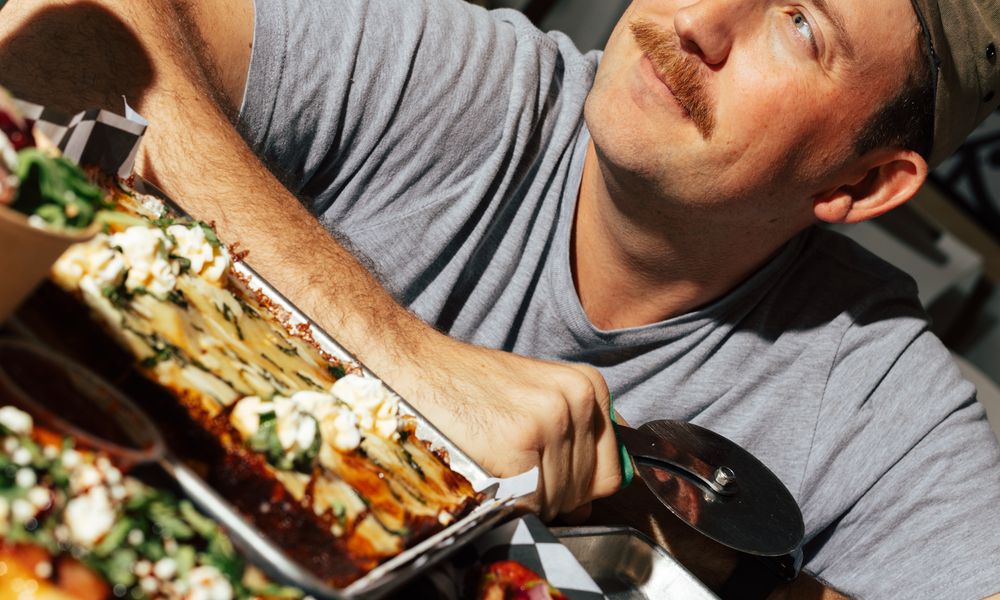
Detroit-style pizza looks like a trend. Square pan, caramelized cheese edge, sauce on top, a line of people photographing it. What it actually is, and the reason I sell it, is the most system-friendly pizza an operator can put on a menu. This post is the whole program: what makes it Detroit, why it behaves so well in a real kitchen, the five decisions that make or break it, and the order I’d roll it out in.
I make Detroit-style pan pizzas every day. They’re on the menu boards of my restaurant and both my trucks. What follows isn’t a home recipe. It’s the operator’s view: what has to be true in your building for this pizza to make you money twice a day, every day, without you standing over it.
What makes it Detroit-style (and what’s negotiable)
The style comes from Buddy’s in Detroit, 1946, where the first pans were blue steel utility trays borrowed from the automotive world. Almost eighty years later the definition still lives in five things:
- A rectangular steel pan. Not a sheet tray. A deep, seasoned pan that fries the bottom of the dough in fat while the inside stays open and light.
- Cheese to the edge. All the way. The cheese that touches the pan wall caramelizes into the crisp, dark lace the whole style is famous for. People will argue about toppings, but nobody’s allowed to skip the edge.
- An airy, high-hydration crumb. The interior should read closer to great focaccia than to a cracker. That comes from a wet dough and a real proof, not from wishing.
- Sauce with the confidence to sit on top. The classic “red top” lays the sauce over the cheese in stripes after the bake or late in it. You can sauce under and still be delicious. You’re just drifting from the flag.
- Pepperoni under the cheese if you’re honoring tradition, so it crisps against the dough instead of drying out on top.
Everything else (toppings, drizzles, whether you call the corner pieces the best seats in the house, which they are) is your menu, not the style.
Why this is the pizza a systems guy loves
My operating order is systems > training > quality > service. Detroit-style is the rare product where the system is built into the physical object. In this post you’re really learning one idea: the pan does jobs you normally need skilled labor to do. Chains spend millions engineering menus so the equipment carries the skill. Detroit-style hands an independent the same trick for the price of a pan.
The pan is your portion control. A round pie depends on a human stretching the same 16 inches every time, at volume, in a rush. A pan pizza depends on a scale: the same grams of dough into the same pan, every time. The pan sets the size, the shape, and the thickness ceiling. Your least experienced hire can’t stretch a pizza wrong that never gets stretched.
The proof does the shaping. Dough gets pressed toward the corners, rests, gets pressed again, and the proof (warm, covered, unhurried) does the rest. This is the part of the craft that’s schedule-shaped rather than skill-shaped, which means it’s trainable in days, not months. (You can guess why a consulting brand named Proof Box has affection for a pizza whose hardest step is a controlled rise.)
Par-baking turns rushes into arithmetic. The near-universal operator move with this style: bake the crusts partway in slow hours, hold them, then finish with cheese and toppings to order. A finish bake is a fraction of a full bake, which means your Friday-night throughput is decided by math you did on Tuesday, not by heroics at 7pm. Rushes stop being scary when the oven’s hardest work already happened.
The specs want to be written down. Grams of dough per pan. Grams of cheese per pan, edge included. Sauce by the ladle, laid in stripes. A finished-corner photo taped above the station. Detroit-style is almost annoying in how well it converts into a one-page spec sheet, which is exactly what you want, because a spec sheet is a thing you can train, audit, and hand to the next hire.
It earns a premium. A distinctive square with a caramelized edge doesn’t price like a commodity round pie, and it photographs like free advertising. I won’t hand you a fake margin number here, because your cheese cost and your market set it. But the pricing power is real and you should use it.
The five decisions that make or break it
Here’s where adding the style goes right or wrong. Not the recipe. The decisions around the recipe.
1. The pans
Real Detroit pans: seasoned steel, or anodized aluminum if you’d rather buy your way out of the seasoning ritual. The two standard sizes are 8×10 (personal-ish) and 10×14 (the shareable one). Pick one size to launch. Two sizes on day one doubles your dough weights, your cheese specs, your par-bake counts, and your chances of getting one of them wrong.
Steel pans need a seasoning program: oiled, baked, never soaped, rotated so no pan sits wet. That’s not romance. A stripped pan sticks, and a stuck pizza at service is a small kitchen fire drill. Put pan care on the closing checklist the same day you put the pizza on the menu.
2. The dough
Detroit dough runs wet, commonly somewhere in the 65–75% hydration range, and that wetness is where the open crumb comes from. Where exactly your number lands depends on your flour, your mixer, your walk-in space, and your service windows. I’m not going to pretend the internet can hand you the number. Dialing it to your building is literally what I do for clients.
What I will insist on: whatever your numbers are, the recipe is a schedule, not a paragraph. Mix time. Fold-and-rest times. Pan-press times. Proof time and temperature. Cold-hold window. If your dough program can’t be executed by someone who isn’t you, on a day you’re not there, twice, you don’t have a dough program. You have a hobby with payroll.
3. The cheese
Tradition says Wisconsin brick cheese: high fat, melts rich, browns into that edge like it was born to. Plenty of respectable programs blend brick with low-moisture mozzarella, or run mozz-forward blends where brick is hard to source. The style survives the substitution. What it doesn’t survive is eyeballing: the edge is a spec (a weight of cheese per pan, deliberately pressed to the walls), not a vibe. Weigh it. Cheese is one of your most expensive ingredients, and “a little extra” times four hundred pans a month is a real number with your name on it.
4. The oven you already own
You don’t need a new oven to add Detroit-style. You need to learn what your oven does to a pan. Decks, conveyors, and convection ovens can all produce a great square, at different temperatures, times, and rack strategies, usually somewhere in the 450–550°F conversation, always settled by test bakes rather than by a blog post. The pan changes everything about heat transfer: what mattered for your round pies tells you less than you’d hope.
Budget real test-bake time before launch: different corners of your oven, different par-bake times, full bakes versus two-stage. Take notes like it’s science, because it is. The output of that week is your bake spec, not pizza.
5. The gum line: the failure everyone hits
Ask any operator who’s added pan pizza about their first month and you’ll hear about the gum line: that dense, wet, underbaked seam where the toppings meet the crumb. It’s the style’s signature failure, and it’s almost always a system problem, not a talent problem: dough too cold going in, pans overloaded with sauce and cheese, a bake that got shortened at rush, a proof that never really happened. Every one of those has a written-schedule fix. If your squares are gummy, your process is lying to you somewhere, and the spec sheet is how you interrogate it.
The rollout, in order
If I were adding Detroit-style to a menu next month (a truck, a pizzeria, a restaurant adding a pizza program) this is the sequence:
- Run it as a special first. One size, one or two builds, Friday and Saturday only. You’re testing your dough schedule and your oven, not your market. The market already likes pizza with a caramelized edge. The question is whether your process holds.
- Write the program while it’s small. Recipe-as-schedule, pan specs, cheese weights, sauce pattern, par-bake counts, the QC photo of a correct corner. One page. If it doesn’t fit on one page, it isn’t a spec yet.
- Train two people, never one. One trained person is a single point of failure with a phone number. Two is the beginning of a system. Watch them run it without you in the room before you call it trained.
- Price it like the premium it is. Distinctive product, visible craft, real cheese cost. Don’t let it slide into slice-parity pricing out of nervousness.
- Decide your par-bake rhythm. How many bases, held how, for which dayparts, and what happens to unsold bases (staff meal has never been fancier).
- Watch one number weekly. Did the squares make money this week? Food cost against sales, honestly counted? A new product without a weekly number is a rumor. My free Simple Truck P&L is built for exactly this habit, truck or not.
When you shouldn’t add it
Skip Detroit-style, at least for now, if your oven can’t hold steady heat at pan-pizza temperatures and you can’t budget the test time to find out, if your line genuinely has no room for pan storage and a press-and-proof station, or if your menu is already too long to execute - a new signature added to a bloated menu is just another button. Fix the menu first. (I have opinions about short menus that apply well beyond the POS.)
The square is a system you can buy finished
Everything above is doable solo with test bakes and patience. That’s how everyone who’s good at this got good. If you’d rather compress months of test bakes into weeks, dialing pizza programs is one of the specific things I sell: the Pizza Dial-In is your dough on a written schedule, your bake matched to your actual oven, and your team trained to repeat it without you watching. Detroit and NY style are home turf.
Either way, start small: one pan size, one weekend as a special, a written spec, and a real number at the end of the week.