
Truck vs. Trailer: I Bought a Trailer. Here’s the Honest Math.
- food-truck
- trailer
- startup-costs
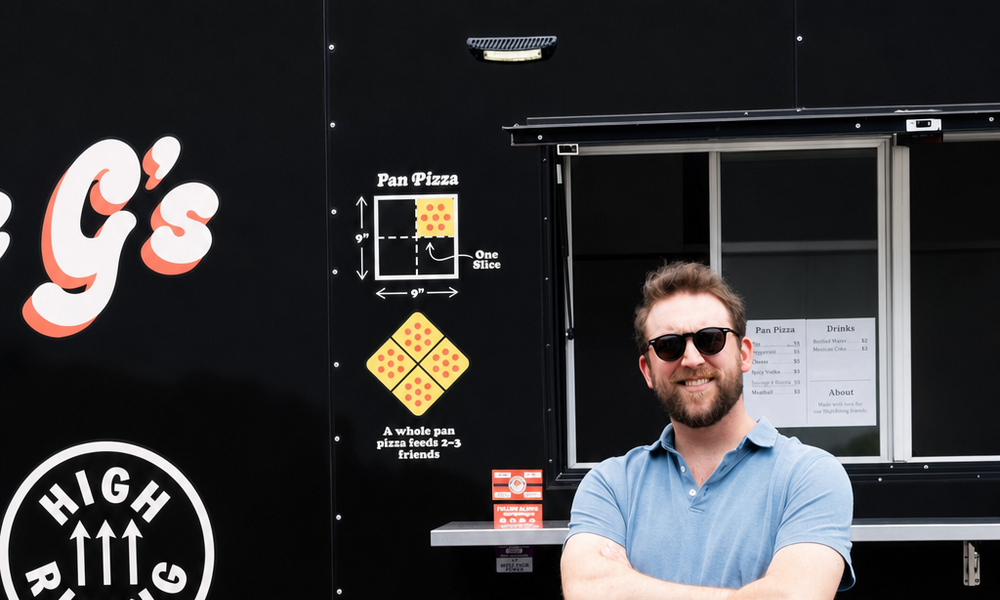
Everybody planning a mobile food business hits the same fork in the road: truck or trailer? And everybody wants a one-word answer. Here’s mine. I bought a trailer, I’d probably buy a trailer again, and there are exactly two situations where I’d tell you to buy a truck instead. The rest of this post is the math behind that sentence.
Where my bias comes from
I started making pizza out of my house during COVID and running pop-ups. In 2021 I put $21,456 into my first rig and did $110,000 in revenue out of it that same year. That rig is a trailer. It’s in the photos all over this site. A second rig in 2022 took me to $550,000. Then $1.1 million in 2023, and $1.4 million in 2024 once the restaurant opened alongside both rigs. There are four trailers on the books now ($21,456, then $91,689, then $71,372, then $38,141), and no two of them were built for the same job.
I’m not listing those numbers to impress you. I’m listing them so you know where I’m standing when I hand out advice. A trailer is what I could afford in 2021, and it worked. But I’ve parked next to a lot of trucks at a lot of events since then, and I’ve watched trucks do things my trailer can’t. What follows is a decision framework, because the answer really is “it depends,” and I can tell you exactly what it depends on.
The side-by-side
One ground rule first: every dollar figure below that isn’t mine is an industry range, checked against current listings as of mid-2026, but ranges still lie if you don’t check them against your own market. Verify everything locally before you sign anything.
| What you’re comparing | Truck | Trailer |
|---|---|---|
| Up-front cost | Equipped used builds commonly land around $50k–$125k, new custom builds $100k–$200k+ | Wide range: $15k–$80k depending on size and build-out. My four builds ran $21,456 to $91,689. |
| Tow vehicle & driving | Drives itself. One machine to buy, register, and park. | Needs a real tow vehicle, typically a ¾-ton or bigger pickup, $15k–$60k used if you don’t already own one (clean late-models cluster at the top of that). And you have to learn to back it up. |
| Power (generator & propane) | Ovens run propane either way; the generator covers refrigeration, lights, and the POS. Trucks often mount the generator onboard in one tidy package. | Generator rides the tongue or the truck bed. Quiet inverter units run $1k–$5k; bigger commercial units cost more. Same propane math as a truck. |
| Maneuverability & parking | Better in tight streets and quick repositioning, though a step van still isn’t small. | Long combined length while towing, and backing is a skill. But you can drop it: trailer stays put, tow vehicle goes home. |
| Commissary & storage | One unit: where it sleeps, the whole business sleeps. | Can live in a secured lot or a driveway (check local zoning and HOA rules first) while the tow vehicle stays your daily driver. |
| Permitting quirks | Usually the default the rules were written around, with fewer weird edge cases. | Some jurisdictions handle towed units differently. A few want the rig able to move under its own power. Entirely county-by-county, call yours before you buy anything. |
| Breakdowns | Kitchen and engine are the same machine. Engine in the shop means kitchen closed. | Tow vehicle dies? Borrow or rent anything with a hitch and make the gig anyway. |
| Resale | Bigger buyer pool, but the vehicle half ages like a vehicle, so resale swings hard with mileage and market. | No odometer on the kitchen and fewer wear parts, value still hinges on build quality and local demand. |
| Site access at events | Pulls in, parks, done. Organizers know exactly what a truck needs. | Tight urban sites can be awkward with a truck-plus-trailer combo. Measure your combined length against the slot before you commit to it. |
The rig is only one line of the real budget, by the way. If you want the whole thing broken out line by line (permits, equipment, the stuff nobody tells you about) I wrote that up in How Much Does a Pizza Food Truck Cost?
The three questions that actually decide it
Most people compare trucks and trailers like they’re two products on a shelf. Wrong frame. You’re comparing two products against your situation, and three parts of your situation do almost all the deciding.
1. What are you towing with?
This comes first because it can end the conversation. A loaded pizza trailer is heavy: oven, water tanks, refrigeration, prep equipment, product. A 16–20 foot kitchen trailer commonly loads to 7,000–12,000 pounds, and you check that against your vehicle’s actual tow rating, not the brochure number. If you already own a pickup that can pull that safely, the trailer math gets good immediately. You just skipped an entire vehicle purchase, and your tow vehicle keeps doing normal-life duty the other six days a week.
If you don’t own one, be honest: add the tow vehicle to the trailer’s price tag before you compare anything. Sometimes that closes the gap with a used truck. Sometimes it doesn’t. But compare the whole stack, not the sticker.
And ask the question nobody asks until it’s too late: can you back a trailer? It’s learnable. A weekend in an empty parking lot gets you most of the way there. Learn it before there’s an audience.
Every event lot has one guy whose entire job, apparently, is standing there watching you back your trailer in. Early on, I was the pre-show entertainment. Practice in the empty lot first.
2. Where will your city actually let you sell?
This is the biggest factor, and almost nobody researches it before buying. Go find your real sites. Not “food trucks do well downtown,” but the actual breweries, festivals, farmers markets, office parks, and event slots where you’d park.
If your calendar looks like mine (booked events and breweries where somebody assigns you a slot and you sit in it all service) a trailer gives up nothing. You arrive, you drop, you cook, you leave. Nobody cares that your kitchen doesn’t have its own engine.
But if your plan is daily street service (a downtown lunch rotation, metered curb spots, moving twice a day to chase foot traffic) hitching and unhitching on a schedule will grind you down. That’s truck country. A truck moves when you turn a key, and that difference is worth real money if you move often and worth almost nothing if you don’t.
Notice that nothing in that answer was about vehicles. The real question under this whole post is whether your revenue arrives by appointment or by hunt. An appointment business gets assigned a slot, drops, and cooks. A hunting business chases its customers across a city on a clock. Those are two different revenue models that happen to be sold at the same festivals, and the rig is just the shape each one takes. People agonize over truck versus trailer because it feels like the big irreversible decision, but the actual decision is what your calendar is going to be made of, and the rig is just its shadow. Book the calendar first, even on paper, and the vehicle mostly picks itself.
Then read the rules. Some cities’ vending ordinances have odd edge cases for towed rigs: a few want the unit able to move under its own power, some restrict where an unhitched trailer can sit. This is entirely local: read your city’s mobile vending ordinance and call your health department before buying anything. Twenty minutes on the phone now beats owning the wrong rig for five years.
3. What’s your commissary and storage situation?
Many health departments require mobile food units to work out of a licensed commissary, a commercial kitchen where you prep, refill fresh water, dump gray water, and store product. Requirements vary a lot by county, so confirm yours before you build a plan around skipping it. Whichever rig you buy, that relationship shapes your week, so sort it early.
Storage is where the trailer quietly wins. Mine can sit in a secured lot with the tongue locked while the tow vehicle goes home. A truck is one big unit: wherever it sleeps, your whole business sleeps there, and you’re still driving something the size of a delivery van to get milk.
Then there’s the risk nobody prices in: breakdowns. A truck’s kitchen and engine are the same machine, so engine trouble closes the kitchen while a mechanic works through his queue. With a trailer, if the tow vehicle dies, you borrow or rent anything with a hitch and still make the weekend. Separating the thing that cooks from the thing that drives is a genuine risk decision, not just a cost decision.
Why I went trailer
In 2021 I went trailer because $21,456 was what I had. But the reasons I’d do it again are better than “it was cheap.”
The cash I didn’t spend became the business. Getting open for $21,456 instead of the $50k–$125k an equipped used truck runs meant I wasn’t buried in payments while I was still learning. The gap between those two numbers paid for mistakes, inventory, and slow months. My growth ($110k, then $550k, then $1.1 million) happened partly because the first rig was cheap enough to survive its owner figuring things out on it.
More kitchen per dollar. With a trailer, your money buys kitchen. With a truck, a chunk of your money buys a drivetrain. You get a bit more room in a trailer, and more ability to customize the build, too. When the budget is tight, I want dollars going into the oven, the cold storage, and the workspace my crew stands in for a whole shift. That last part isn’t a throwaway. A rig your people can work in without dreading it is part of being an employer worth working for.
The rig was never the point. My operating order is systems > training > quality > service, in that order, every time. A truck and a trailer are both just boxes you put systems in. Customers don’t buy your drivetrain. They buy consistent food from a clean rig with fast, friendly service, and none of that comes from the vehicle. Buy the cheapest box that meets code and fits your sites, then spend the difference building an operation that runs without you standing in it every shift. That freedom is the actual goal, and it’s most of what I help owners build now.
When I’d tell you to buy a truck instead
Two situations, like I promised.
1. You’re running daily street service with multiple moves. Downtown lunch rotation, curbside vending, spots that turn over: if your model has you relocating every day or twice a day, buy the truck. Hitching, unhitching, and backing into tight curb slots on a clock is a time problem, and it never goes away. Turn-key mobility is exactly what the truck premium buys. You’re running a hunting calendar, and hunts need the truck.
2. You have no tow vehicle and nowhere to keep a trailer. If you’d have to buy a heavy pickup and rent storage anyway, add those numbers up honestly. Run it with your local used-truck and storage prices, because the trailer’s cost advantage can shrink to nothing, and the answer flips depending on your market. At that point one used truck is the simpler machine: one purchase, one insurance conversation (coverage genuinely differs between motorized and towed units, so talk to an agent who actually handles mobile food businesses), one thing to think about. Simple has real value, especially in year one.
If neither of those is you, give the trailer a hard look. Mine carried me from pop-ups out of my house to a real multi-unit operation, and it’s still out there working every week.
Run the math before you fall in love
Whichever way you’re leaning, don’t decide standing in a seller’s parking lot with your heart rate up. Run your numbers first. My free truck P&L worksheet will show you what your market can actually pay you before you commit to either box.
And before you spend the first dollar on a rig, walk through my free launch checklist. It’s every step I wish somebody had handed me in 2021, in the order I’d actually do them.
Questions people actually ask.
Should I buy a food truck or a trailer?
For a calendar built on booked events and assigned slots, the trailer. Buy the truck if you're running daily street service with multiple moves a day, or if you'd have to buy a tow vehicle and rent storage both.
Why do you run trailers?
Four builds in, three reasons: more kitchen per dollar, a bit more room and the ability to customize the build, and the kitchen isn't welded to an engine.
What happens when the vehicle breaks down?
With a truck, the kitchen goes to the shop with the engine. With a trailer, you rent or borrow anything with a hitch and still make it to the gig that day.
What do you need to tow a kitchen trailer?
A real tow vehicle, typically a three-quarter-ton pickup or bigger. A loaded 16 to 20 foot kitchen trailer commonly runs 7,000 to 12,000 pounds, checked against the vehicle's actual tow rating, not the brochure number.
Do trailers hit permit problems trucks don't?
Sometimes. A few jurisdictions want a unit that can move under its own power, and some restrict where an unhitched trailer can sit. It's entirely county-by-county, so read your city's vending ordinance before you buy.